Squamish Development Pressure and What It Means for Exterior Remodel Scheduling

Squamish Development Pressure and What It Means for Exterior Remodel Scheduling
A significant new housing development has received council approval in Squamish’s University Highlands neighbourhood, bringing plans for roughly 424 residential units along with mixed-use space near Capilano University. The project includes a mix of apartments, townhomes, and commercial components, and reflects the District’s broader effort to expand housing supply.
For homeowners planning exterior renovations, this isn’t just a background headline. Large-scale development has practical ripple effects across the local construction market. It affects trade availability, permitting timelines, material lead times, and project scheduling — all factors that shape how exterior remodels unfold in Squamish and the broader Sea-to-Sky region.
Understanding these forces helps homeowners plan realistically and avoid being surprised by delays that are structural, not personal.
Local Construction Activity Competes for the Same Trades
Squamish is growing in multiple directions at once. Council approvals for multi-hundred-unit developments are part of a broader shift toward higher housing volume in the region.
Even though large developments and single-family remodels look like different worlds, they draw from the same finite pool of skilled labour: framers, siders, window installers, scaffold crews, roofers, and finish carpenters. When development work ramps up, renovation scheduling becomes more competitive.
This is one reason exterior remodels can feel harder to “slot in” during peak building cycles.
Trade Capacity Is a Real Constraint in a Small Market
Homeowners often wonder why it can take months to secure a start date.
Part of the answer is trade capacity. When larger developments in University Highlands, Downtown Squamish, and Britannia Beach get going, they tend to book trades in long blocks with predictable sequencing and steady volume. Renovation work is different: it is more detailed, more variable, and often requires tighter coordination around existing conditions.
In a busy market, contractors who primarily serve development work may treat residential remodels as fill-in projects rather than priority work. By contrast, smaller renovation-focused firms with established in-house crews and stable local subcontractor relationships tend to schedule homeowners differently — with more continuity and less reliance on whatever labour is available last minute.
Ask your contractor:
Do you primarily work in residential renovations, or do you also staff large development projects?
Who will actually be on site doing the work — in-house crews or rotating subcontractors?
The answers often tell you how predictable your schedule will be.
Permitting and Inspection Queues Can Stretch During Development Surges
Large developments also increase municipal workload. Planning departments and building inspectors are finite resources at the District level. When multi-unit projects enter active permitting phases, residential renovation permits can face longer review windows simply due to volume. (In Squamish this typically adds 4-6 more weeks to existing queues.)
Exterior remodels may require permits for:
Structural façade changes
Window and door reconfigurations
Insulation or envelope system upgrades
Significant alterations to exterior assemblies
You shouldn’t avoid permitting. Instead, schedules should include administrative time that is outside any contractor’s direct control.
A renovation-specialized builder can help here by defining scope clearly, preparing complete documentation, and avoiding permit re-submissions that slow the process further.
Material Lead Times Become Less Predictable
Material availability is another pressure point during development cycles. Larger projects often place bulk orders that secure delivery windows months in advance. That can affect access to:
Cladding and trim packages
Window and door units
Specialty flashings and membranes
Insulation products
For homeowners, this often shows up as a disappointing gap: labour is ready, but materials are not.
This is where local supply chain strength is critical. Contractors with long-standing relationships with regional suppliers and experience staging renovation materials early tend to avoid the stop-start delays that frustrate homeowners.
Ask your contractor:
When do you order exterior materials relative to the construction start date?
Do you have established supplier relationships locally, or are materials sourced opportunistically project-to-project?
Cost Pressures Reflect Market Demand
Busy construction markets also create pricing pressure. When labour is booked months out and suppliers are stretched, costs shift accordingly:
Higher labour rates during peak season
Premium pricing for securing specific trades
Longer scaffolding rentals if sequencing slows
Increased contingency allowances for unknowns
For homeowners in Squamish (and particularly in Whistler), it’s useful to understand that this is not simply “contractors charging more.” It is how constrained capacity shows up in a growing regional market.
Renovation-first firms that keep steady crews, avoid overbooking, and plan work through structured preconstruction tend to provide more stable pricing and fewer mid-project schedule surprises.
Practical Planning Implications for Exterior Remodels in Squamish and Whistler
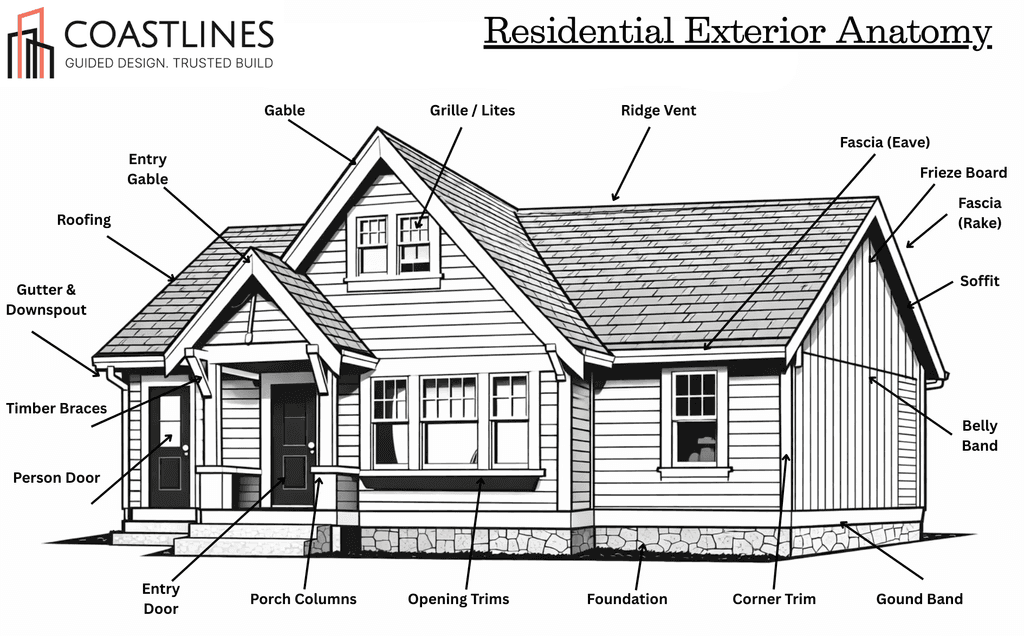
If you are planning exterior work in Squamish — siding, windows, envelope upgrades, soffits, fascia, or full façade redesign — development pressure points towards:
Start contractor conversations earlier than you think you need to
Expect that trade scheduling is a real variable, not a simple calendar choice
Clarify material lead times at the beginning, not after demolition
Build weather flexibility into the plan, especially in shoulder seasons
Prioritize contractors who specialize in homeowner renovation work, not those treating remodels as secondary to larger builds
The goal is not to “beat the market.” It is to work with a builder whose systems are designed for residential renovation specifically.
What Homeowners Should Watch for Next
Squamish development momentum is obviously expected to continue. Housing approvals and construction starts will keep shaping trade availability, permit queues, and material demand.
Homeowners planning remodels should watch for:
Public construction timelines on major developments
Shifts in municipal inspection capacity
Supplier lead-time changes for common exterior products
Seasonal trade availability patterns in the Sea-to-Sky
They directly influence how smoothly an exterior renovation can proceed.
Closing Note
In a small and growing construction market like Squamish, scheduling pressure is part of the ecosystem. The most reliable way to reduce disruption is to work with a contractor whose labour, supply chains, and planning process are built around homeowners first — not around fitting renovation work into the margins of larger development cycles.
Questions Related to the News
How far in advance should I book an exterior remodel in Squamish?
For most exterior renovation work in Squamish — especially siding replacement, window upgrades, or envelope improvements — it is wise to start contractor conversations several months ahead of your ideal construction window. In a busy season, the difference between early planning and late planning can be the difference between a spring start and waiting until late summer. Three months is a minimum — six months is ideal.
Why is it hard to get a contractor start date in the Sea-to-Sky?
The Sea-to-Sky construction market is small, and the skilled trades involved in exterior work are shared across renovations and larger development projects. When multi-unit construction ramps up locally, trade availability becomes tighter, and residential remodel scheduling becomes more competitive.
Do large housing developments affect residential renovation timelines?
Yes. Large developments draw from the same pool of framers, cladders, scaffold crews, and window installers that residential projects rely on. They can also increase municipal permitting and inspection workloads, which may extend timelines for certain exterior renovation approvals.
Will exterior renovation permits take longer during busy construction periods?
They do. Exterior remodels that involve structural changes, new openings, or significant envelope upgrades often require permits. When the District is processing a higher volume of development permits, review and inspection queues can lengthen. Homeowners should factor administrative time into early project planning.
Why do renovation quotes and schedules vary so much between contractors?
In many cases, differences come down to scope assumptions, labour structure, and scheduling priorities. Contractors who primarily serve larger development work may approach residential remodels differently than firms that specialize in homeowner renovation projects with stable crews and established local supplier relationships.
What should homeowners ask a contractor about scheduling reliability?
Two useful questions are:
Do you primarily work on residential exterior renovations, or do you also staff larger development projects?
When do you order key exterior materials relative to the construction start date?
Clear answers usually indicate whether scheduling is structured and homeowner-focused.
What can homeowners do to reduce delays in an exterior remodel?
The most effective steps are early planning, clear scope definition, and early material selection. Projects move more steadily when contractors can order materials in advance, schedule trades predictably, and avoid mid-project decision gaps that slow sequencing.