The Anatomy of Your Home Exterior and The Scope of a Remodel
What “Residing the House” Typically Includes
In the Sea-to-Sky, “residing the house” can mean very different things depending on how comprehensive the renovation is intended to be. For some homeowners, it refers to replacing the visible cladding. For others, it involves renewing most of the exterior assembly.
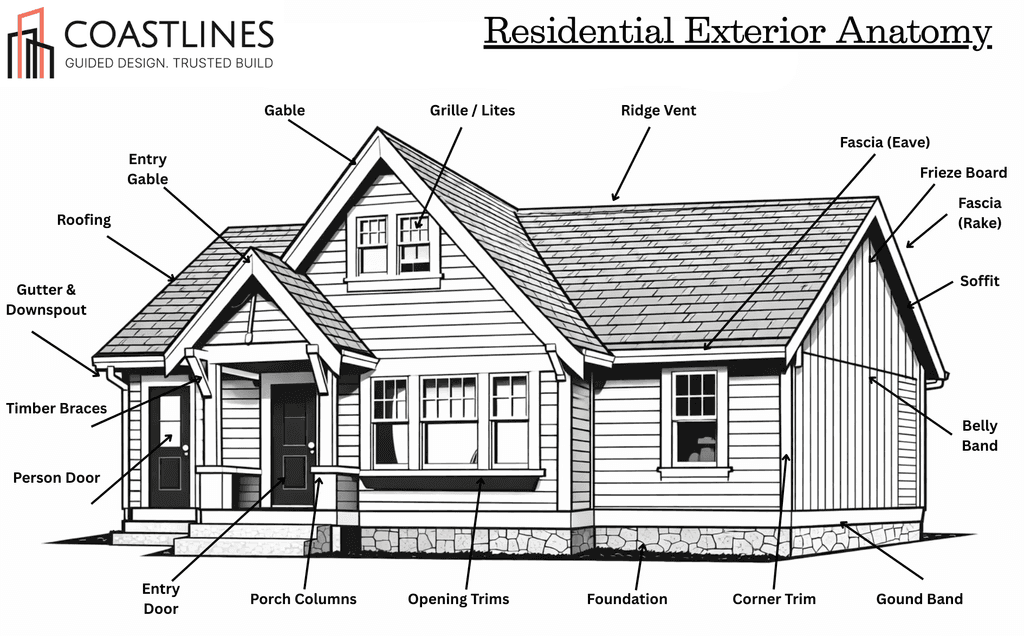
Before pricing begins, it helps to understand what makes up a typical exterior and which components may be part of the scope. Exterior renovation is layered work. Each layer connects to the next, and decisions in one area influence outcomes in another.
Below is a clear breakdown of what is often involved in a full exterior remodel in Squamish or Whistler.
1. Demolition and Remediation
Every exterior remodel begins with removal. The extent of demolition depends entirely on the intended scope.
This can include:
Existing siding or shingles, including hidden layers underneath
Trim boards and corner details
Old flashings
Windows and doors (if being replaced)
Gutters and downspouts
Deck railings or full deck assemblies
Removing siding exposes the sheathing and framing beneath. In many 1980s and 1990s homes in Squamish, it is not uncommon to find layered materials, partial housewrap installations, or previous repair work that was concealed behind cladding. Occasionally, localized rot is discovered around windows, deck ledgers, or roofline transitions.
Demolition is not simply teardown, but it is also a discovery phase and an opportunity to repair and remediate. If you won’t be on site during your remodell, it’s worth planning a walkthrough once the cladding is stripped back so you can review with your contractor what’s been found.
2. The Envelope
Behind the siding sits the building envelope — the layer that manages water and air. Keeping your home warm and dry is not actually the job of the siding, but the envelope.
A full reside always includes:
New water-resistive barrier (WRB), such as housewrap or membrane
Rainscreen strapping to create a drainage cavity
Through-wall flashings at horizontal transitions
Corrected window integration
The water-resistive barrier is installed over structural sheathing and is intended to direct water downward and out of the wall assembly. Older homes did not come close to meeting current code and construction standards.
Rainscreen strapping — typically vertical wood strips — creates a small air cavity (called a capillary break) between the WRB and the siding. In Squamish’s damp winters and humid shoulder seasons, that cavity allows incidental moisture to drain and dry. Without it, siding sits tight to the wall, reducing drying potential.
Through-wall flashings are critical at horizontal breaks such as deck attachments, band boards, and window heads. These thin metal or membrane components are often invisible once complete, but they direct water outward at vulnerable junctions.
Some projects include exterior insulation upgrades, particularly when improving comfort or energy performance is a goal. Adding rigid or mineral wool insulation over sheathing changes wall thickness and affects window depth, trim projection, and proportion in addition to the performance benefits. It is not a universal requirement, but when included, it influences many subsequent design decisions. (Over half of our siding projects in Squamish have been adding insulation since 2022).
Be prepared to think through with your contractor the hidden costs and benefits of the envelope itself.
3. The Cladding Package
The visible siding is only part of the finished exterior. It operates within a trim and detailing strategy that defines how the house reads architecturally.
A cladding scope typically includes:
The siding itself
Corner trims, window and door casings
Sealants and expansion detailing
While we typically start the estimating process using unit rate costs, trim complexity is a crucial detail, specific to each home. (On a recent Valleycliffe remodel, the material costs of trim was 75% the material costs of the siding itself.)
The effect of trim on design looks subtle on paper, but in a completed project it is these details which determine the level of refinement and elegance (not to mention performance) of the home.
Sealants are small but essential details. Proper joint spacing and expansion planning prevent cracking and premature maintenance issues, particularly in climates with temperature swings. On fiber cement facets, the caulking is actually the final waterproofing component and the siding will fail if it is installed improperly.
In some renovations, decorative trim elements are revised or removed entirely, including:
Ground bands
Belly bands
Gable bands
Frieze boards
These elements divide storeys or emphasize rooflines. Removing them can simplify a façade; reworking them can modernize an otherwise traditional home. Leaving them unchanged while altering siding profile can create inconsistency.
Changing siding without reconsidering trim hierarchy often results in a partial transformation rather than a cohesive redesign.
4. The Cornice (Soffit, Fascia, Gutters)
The roof edge defines the top line of the house and often determines how crisp or dated the façade feels.
This area includes:
Soffits (often vented)
Fascia boards
Gutters and downspouts
Soffits provide ventilation to the attic or roof assembly. During renovation, they may be replaced in wood, aluminum, or fiber cement to match the updated cladding palette. Venting requirements must be considered along with design.
Fascia boards define the thickness of the roofline and support the gutter system. A new siding installation paired with weathered fascia often creates an underwhelming final product.
Gutters and downspouts manage roof runoff. In Squamish’s heavy rainfall, properly sized and well-placed drainage systems are essential. Renovations frequently include new gutters to coordinate colour and ensure reliable water control.
Leaving the cornice untouched during a comprehensive reside can limit the overall impact of the renovation, even though none of these elements might have been considered in the first desire to ‘reside the house’.
5. Windows and Doors
Openings are fully embedded within the envelope, and while it is certainly possible to remove and replace windows without removing the siding, it is a much higher performing install if the crew is working directly against the sheathing. Windows and doors are expensive though, so careful reflection is important. If you’re windows have less than 10 years life left, and you are siding with a higher end finish, it may be worth delaying the renovation until you have financing to combine windows with the siding work.
Scope may include:
Window replacement and location/size adjustment (enlargening or moving windows requires a permit in Squamish. Whistler has more complicated jurisdictions with different requirements in different parts of the Greater Whistler Area)
Slider replacement
Specialty entry doors
Replacing windows during siding removal is often efficient because flashing integration can be completed cleanly while walls are open. Attempting to retrofit window detailing after cladding is installed is acceptable but lower quality.
In some renovations, window sizes are adjusted or grouped differently to modernize the façade. Even small proportional changes can shift how rooms function.
Entry doors are frequently upgraded for aesthetic reasons as well as security and insulation performance. Because the entry is a focal point, coordinating door style with siding profile and trim strategy improves cohesion. Entry doors are typically a separate conversation from the replacement of windows, sliders, and person-doors, and worth conserving some budget for. (The design opportunities with modern entry door catalogues is inspiring!)
Window and door supply is usually the slowest part of the supply chain and must be resolved early.
6. Decks
In Squamish, decks are often central to how a home functions. During exterior renovations, they are commonly rebuilt or significantly upgraded.
Deck scope can involve:
Concrete footings or pads
Post and beam substructures
Framing (ledgers, joists, blocking)
Decking (pressure-treated lumber, cedar, composite)
Railings (wood, aluminum, glass, contemporary systems)
Roofing over decks
Just as the siding has an envelope underneath, the deck is supported by three systems of support: concrete footings, post and beam subframing, and the joists, ledgers and blocking which support the deck boards. On a second story deck, the framing can be reviewed and quoted for replacement (if necessary) in advance. In other cases, budget should be reserved, and a site meeting planned, for the first available inspection date after demolition has exposed framing.
Decking surface material influences maintenance and appearance. Pressure treated wood is no longer common, and the use of cedar is fading in Squamish and Whistler as composites have become unbeatable.
Railings dramatically affect the final product. Wood, glass, aluminum, horizontal cable, and composite are all available systems, and can be combined with lighting solutions to finish the deck.
Because decks intersect with siding and envelope work, there is an advantage to scoping it together with the siding, but of course, this is a large scope addition. Deck’s can come second, and be delayed at a relatively small cost for lost efficiency.
7. Lighting
It’s easy to forget about lighting (and house numbers!) during a renovation plan, but a few well placed lights should be considered essential to a thoughtful remodel.
This can include:
Soffit pot lights
Wall sconces
Entry feature lighting
Landscape / walkway lighting
Deck step and railing lights
Although lighting may seem secondary to siding, it is part of the overall exterior composition, and it is much cleaner to run wire for rough in while the boards are off the wall.
Defining Scope Before Pricing
Two projects described as “residing the house” may look similar from the street but involve very different levels of work.
One may include cladding only. Another may include envelope renewal, window replacement, cornice updates, deck reconstruction, and lighting integration.
From a contracting perspective, it can feel like upselling to bring into awareness all of the components of building a world class exterior. But it’s best to start working from this zoomed out view on the first meeting, and see where budget and vision line up.
Homeowners who understand the full composition of a home’s exterior and balance design, performance and budget decisions together get the most of their remodelling projects.
Frequently Asked Questions: Exterior Remodel Scope in Squamish
Do I have to do everything at once?
No. Many homeowners phase exterior renovations over time. The key is distinguishing between elements that are most efficient when walls are open and those that can be scheduled later without undoing completed work.
Envelope corrections, door and window changes, and electrical rough ins should happen when the siding is off. Decks, porches, and roofing can come second.. A clearly defined long-term plan reduces the risk of rework.
How do I decide what to prioritize if the full scope exceeds my budget?
Begin by identifying components that affect durability and water management. These items typically warrant priority because revisiting them later often involves additional demolition.
Next, consider which components are too deeply layered to consider doing them separately. Finally, establish a long term plan of phases with your contractor so that transitions can be dealth with as efficiently as possible, with prep work happening in Phase 1.
A structured estimating process that presents both a complete scope and adjustable alternatives helps clarify these trade-offs without guesswork.
What should I expect from my contractor at the beginning of the process?
You should expect an initial scope-of-work document that outlines, at a high level, what is included and what is excluded. This “skyview” overview helps ensure that both parties are aligned before detailed pricing or demolition begins. For example, a 25+ point checklist of what’s in and what’s out might be something to expect.
You want to see what’s not included, explicitly, as much as what’s included, to prevent “forgotten” items that need to be added later. Robust scope checklists make sure even the things that aren’t involved have still been formally addressed.
Can I replace siding now and upgrade windows later?
It is possible, but depends on a few factors. If windows are likely to be replaced in the near future, coordinating that work with siding removal is a cheaper and better final product. Installing new cladding and then reopening wall assemblies later can increase overall cost, damage integry of the new sidings, and compromise the window seal compared to working with fresh sheathing.
When windows are structurally sound and not part of immediate plans, careful flashing integration during siding installation can allow for future upgrades with minimal disruption. This should be discussed during preconstruction planning.
If using high end architectural or metal sidings, it’s harder to add windows later compared with houses clad in vinyl, wood, or fiber cement.
Will phasing increase my overall cost?
Yes. Multiple mobilizations, overlapping work areas, etc, all cost money. However, if phases are defined clearly and sequenced thoughtfully, the impact can be modest, especially if preparations for future phases are completed during Phase 1 (e.g. future proofing your renovation).
How detailed should the scope be before construction begins?
The level of detail should be sufficient to avoid ambiguity about major components. At minimum, siding type, trim treatment, envelope scope, cornice updates, window involvement, deck work, and lighting should be clearly identified as included or excluded.
Clear documentation does not eliminate all mid-project decisions, but it reduces the likelihood of discovering that expectations differed from assumptions.
But overdocumentation is expensive. Getting into double digits soft cost percentages (e.g., spending more than 10% of total budget on design and drawings) starts to feel like bad value. For exterior renovations without permit requirements, this is a place to spend some value-driven dollars, handled by a design-build team rather than outsourced to a full architectural outfit.
Is it normal for scope to expand once demolition starts?
It is common to uncover conditions that require repair once siding is removed. What is less common in well-planned projects is discovering entirely new categories of work that were never discussed. This should be kept to a minimum, and homeowners should ask their contractor how they control for new and changed scope.
An initial high-level scope review and site investigation reduce the likelihood of dramatic surprises. Some contingencies are realistic; undefined scope is not.